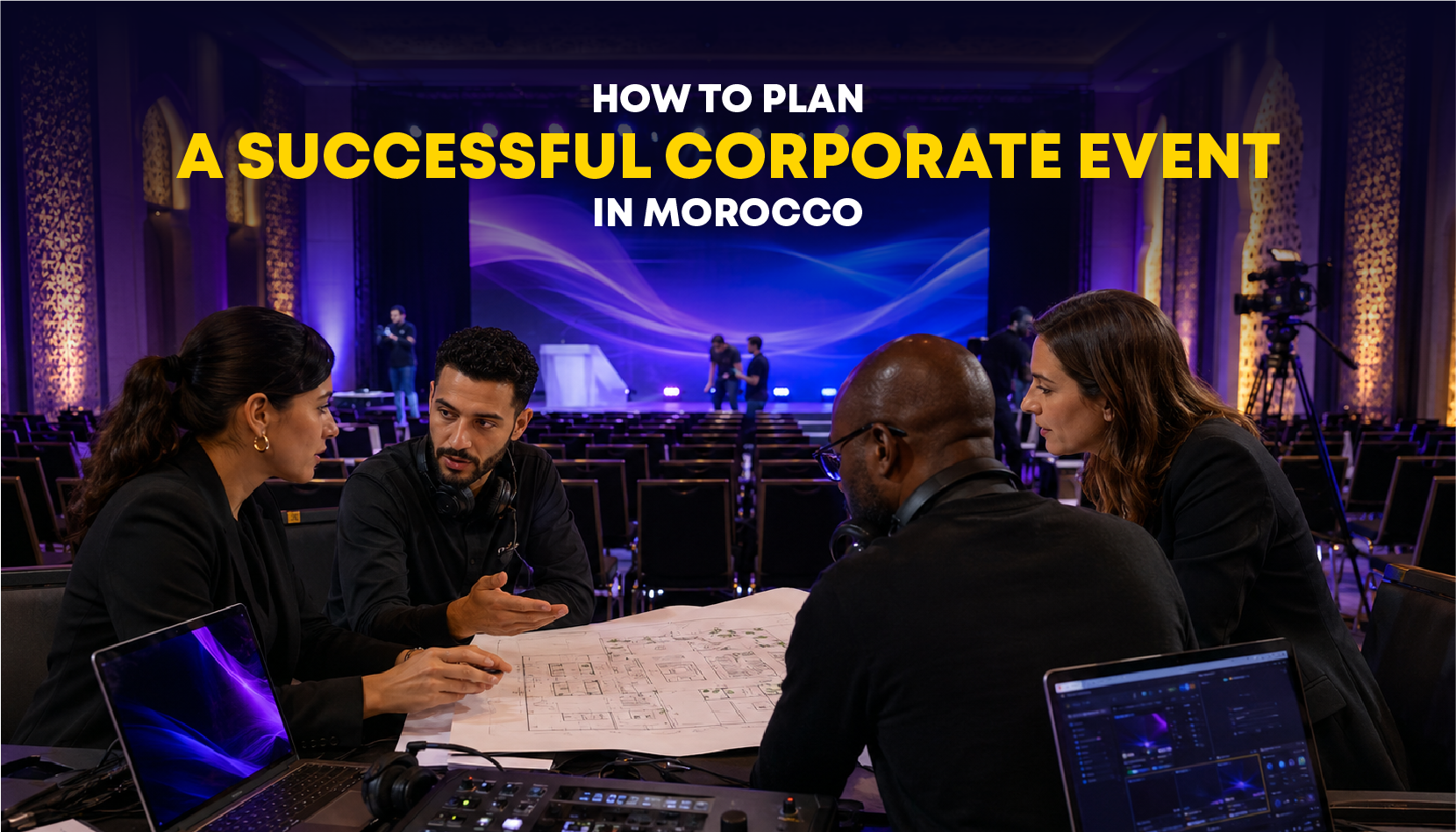
Planning a corporate event in Morocco requires creativity, organization and reliable technical coordination. Whether you are preparing a conference, product launch, business seminar, gala dinner or hybrid event, every decision contributes to the final guest experience.
Morocco offers a wide variety of destinations, venues and production possibilities. Companies can organize events in major business centres such as Casablanca and Rabat, cultural destinations such as Marrakech and Fes, or coastal cities such as Tangier and Agadir.
However, a successful event requires more than choosing an attractive venue. You must define clear objectives, control the budget, coordinate suppliers and ensure that all audiovisual and logistical elements work together.
This guide explains the essential steps for successful corporate event planning in Morocco.
1. Define the Purpose of Your Corporate Event
Before selecting a venue or requesting quotations, identify the event’s primary objective.
A corporate event may be organized to:
- Launch a new product or service
- Present company results
- Train employees or business partners
- Build relationships with clients
- Generate media attention
- Celebrate an achievement
- Strengthen internal communication
- Host an international delegation
Your objective affects the event format, programme, venue, technical requirements and communication strategy.
For example, a product launch may require strong branding, creative staging and professional video production. A business seminar may prioritize clear presentations, comfortable seating and reliable sound equipment.
A clearly defined objective makes every other planning decision easier.
2. Identify Your Target Audience
Understanding your guests is essential for creating an appropriate experience.
Consider:
- Number of attendees
- Professional profiles
- Languages spoken
- Local or international attendance
- Accessibility requirements
- Transportation needs
- Expectations and interests
- In-person or remote participation
An event for company employees will not have the same structure as a conference for international executives, journalists or government representatives.
If international guests are attending, consider multilingual signs, interpreters, airport transfers, accommodation and culturally appropriate hospitality.
3. Establish a Realistic Budget
Your budget should cover the complete event, not only the venue.
Typical cost categories include:
- Venue rental
- Sound and lighting
- LED screens or video projection
- Stage construction
- Decoration and branding
- Photography and video
- Livestreaming
- Catering
- Event staff
- Transportation
- Accommodation
- Security
- Entertainment
- Printing and signage
- Contingency expenses
Reserve approximately 10% of the available budget for unexpected requirements or last-minute changes.
For more detailed pricing information, read our guide about event production costs in Morocco.
4. Choose the Right City
The best city depends on your audience, event format and logistical requirements.
Casablanca
Casablanca is Morocco’s main economic centre. It is particularly suitable for conferences, business meetings, exhibitions and corporate launches.
The city offers hotels, conference centres, restaurants, suppliers and strong transport connections.
Rabat
Rabat is appropriate for institutional events, diplomatic meetings, official conferences and cultural programmes.
Its professional environment makes it a strong choice for companies, public institutions and international organizations.
Marrakech
Marrakech is one of Morocco’s leading destinations for premium corporate events, incentive trips, conventions and international gatherings.
It offers luxury hotels, resorts, palaces and distinctive outdoor venues.
Tangier
Tangier is suitable for business events connected to industry, logistics, international trade and investment.
Its location and modern infrastructure make it an increasingly attractive corporate destination.
Agadir
Agadir works particularly well for retreats, tourism events, incentive programmes and conferences combining business activities with leisure.
Your chosen city will influence transportation, accommodation, supplier availability and the total event budget.
5. Select a Suitable Venue
The venue must support both the creative concept and the technical requirements.
Before confirming a location, check:
- Maximum guest capacity
- Stage dimensions
- Ceiling height
- Electrical capacity
- Internet connection
- Loading and equipment access
- Parking availability
- Sound restrictions
- Setup and dismantling hours
- Emergency exits
- Accessibility
- Available furniture
- Catering rules
A venue may look attractive in photographs but still be unsuitable for professional sound, lighting or LED screen installation.
Arrange a technical site visit before confirming the booking. This allows the production team to inspect access, electricity, internet connectivity, stage position and audience visibility.
6. Develop the Event Concept and Visual Identity
A strong event should communicate a consistent visual message.
The creative direction may include:
- Event logo
- Colour palette
- Stage design
- Digital invitations
- Registration interface
- Branded backdrop
- Directional signs
- Presentation templates
- Social media content
- Guest badges
- Printed materials
- Screen animations
All elements should follow the company’s brand identity while creating a distinctive experience for attendees.
For a product launch, the concept may focus on innovation and discovery. For a gala dinner, the direction may be elegant and celebratory.
CAPART MEDIA can combine branding, digital design and physical event production to maintain consistency across every guest touchpoint.
7. Prepare the Programme
The event programme should be clear, realistic and engaging.
Include:
- Guest arrival and registration
- Welcome session
- Presentations
- Panel discussions
- Demonstrations
- Breaks
- Networking periods
- Entertainment
- Closing session
Avoid filling the programme with long presentations without breaks. Attendees need time to interact, process information and move between different activities.
Share the final programme with speakers, technicians, hosts and the venue team before the event.
8. Invest in Professional Audiovisual Production
Sound, screens and lighting are central to the success of a corporate event.
Sound
Every guest should hear speakers clearly. The production team must select equipment according to the room’s dimensions, acoustics and audience size.
Professional sound production may include:
- Speakers
- Wireless microphones
- Lavalier microphones
- Digital mixing console
- Stage monitors
- Audio technician
- Backup equipment
Screens
LED screens and projectors can display presentations, videos, branding and live camera feeds.
The appropriate screen size depends on:
- Venue dimensions
- Audience distance
- Ambient light
- Content resolution
- Indoor or outdoor use
Lighting
Lighting improves visibility, atmosphere and video quality.
A professional setup may combine:
- Stage lighting
- Speaker lighting
- Decorative lighting
- Architectural lighting
- Branded colour effects
All technical systems should be tested before guests arrive.
9. Plan Photography and Video Coverage
Professional content extends the value of your event beyond the event day.
Your coverage plan can include:
- Event photography
- Speaker portraits
- Guest interactions
- Interviews
- Multi-camera recording
- Social media clips
- Highlight video
- Full conference recording
- Drone footage where authorized
- Post-event promotional content
Prepare a list of important people, moments and brand elements that must be documented.
You should also determine delivery deadlines in advance. Social media photographs may be required during the event, while a cinematic highlight video may need additional editing time.
10. Consider Livestreaming or a Hybrid Format
Livestreaming allows remote guests to participate when they cannot attend physically.
A professional hybrid production may require:
- Multiple cameras
- Video switcher
- Streaming encoder
- Presentation integration
- Dedicated internet
- Remote speaker management
- Audio mixing
- Recording
- Technical monitoring
- Backup connection
The livestream should be planned as part of the main event rather than treated as a simple camera recording.
Remote participants need clear sound, professional visuals and an easy method for accessing the transmission.
11. Coordinate Event Logistics
Strong logistics allow guests, equipment and staff to move efficiently.
Prepare detailed plans for:
- Equipment transportation
- Supplier arrival times
- Installation schedule
- Guest registration
- Speaker reception
- Hotel accommodation
- Airport transfers
- Parking
- Security
- Catering
- Staff responsibilities
- Dismantling
Create one central production schedule showing who is responsible for every task.
For international events, appointing a local event production partner can simplify supplier communication and on-site coordination.
12. Organize a Technical Rehearsal
Never wait until the event begins to test the programme.
A complete rehearsal should verify:
- Microphones
- Presentations
- Videos
- Lighting cues
- Speaker entrances
- Remote connections
- Livestreaming
- Music
- Stage transitions
- Timing
Speakers should know where to stand, how to use the microphone and when their presentations will appear.
The technical team should also prepare backup files and alternative equipment for essential systems.
13. Create a Detailed Event-Day Schedule
The production team needs a precise schedule covering the entire day.
It should include:
- Venue access time
- Installation
- Equipment testing
- Staff briefing
- Speaker arrival
- Registration opening
- Programme timings
- Breaks
- Catering
- Content capture
- Dismantling
Assign one event manager or producer to supervise the complete operation and approve any last-minute decisions.
This prevents conflicting instructions from different stakeholders.
14. Prepare for Unexpected Situations
Even a well-planned event can face last-minute challenges.
Prepare backup solutions for:
- Internet interruption
- Microphone failure
- Presentation problems
- Speaker delays
- Weather changes
- Transport delays
- Power issues
- Programme changes
Important presentations and videos should be saved on multiple devices.
Outdoor events also require weather protection and an alternative plan when possible.
15. Follow Up After the Event
The event does not finish when the guests leave.
Post-event actions may include:
- Sending thank-you messages
- Sharing photographs
- Publishing the highlight video
- Collecting participant feedback
- Reviewing attendance
- Evaluating social media engagement
- Analysing leads
- Organizing recorded content
- Preparing a performance report
Compare the results with the objectives established at the beginning.
This analysis helps determine what worked well and what should be improved for future events.
Corporate Event Planning Checklist
Before confirming your event, verify that you have completed the following:
- Defined the event objective
- Identified the target audience
- Established the budget
- Selected the city and venue
- Completed a technical site visit
- Developed the creative concept
- Confirmed speakers and programme
- Planned sound, screens and lighting
- Organized photography and video
- Prepared livestreaming if required
- Coordinated suppliers and transportation
- Created the production schedule
- Completed a technical rehearsal
- Prepared backup solutions
- Planned post-event communication
Why Work With CAPART MEDIA?
Corporate event production often involves several creative, technical and logistical partners. Working with one coordinated agency can make the process more efficient and consistent.
CAPART MEDIA provides:
- Creative event concepts
- Event branding and graphic design
- Stage and visual production
- Professional sound and lighting
- LED screens and video systems
- Photography and video production
- Livestreaming
- Digital communication
- On-site coordination
- Nationwide event support
We support businesses, institutions and international organizations with professional event production solutions in Kénitra, Rabat, Casablanca, Marrakech, Tangier and across Morocco.
Frequently Asked Questions
How far in advance should a corporate event be planned?
Small corporate events should ideally be prepared several weeks in advance. Large conferences, launches and international events may require several months of planning.
Which Moroccan city is best for a corporate event?
Casablanca is ideal for business events, Rabat for institutional programmes, Marrakech for international and premium experiences, and Tangier for trade and industrial gatherings. The best choice depends on your audience and objectives.
Do corporate events require professional audiovisual equipment?
Professional sound, screens and lighting are recommended whenever presentations, speeches, videos or a large audience are involved.
Can a corporate event be livestreamed?
Yes. Conferences, seminars and product launches can be produced in a hybrid format for remote audiences. A dedicated internet connection and professional streaming equipment are recommended.
Can CAPART MEDIA manage events throughout Morocco?
Yes. CAPART MEDIA can coordinate corporate events and audiovisual production in different Moroccan cities according to the project’s requirements.
Plan Your Corporate Event in Morocco
A successful corporate event combines a clear strategy, strong creative direction, reliable technical production and detailed coordination.
CAPART MEDIA helps companies and organizations transform their objectives into professional event experiences across Morocco.
Planning an upcoming conference, product launch or corporate event? Contact CAPART MEDIA for a personalized proposal.