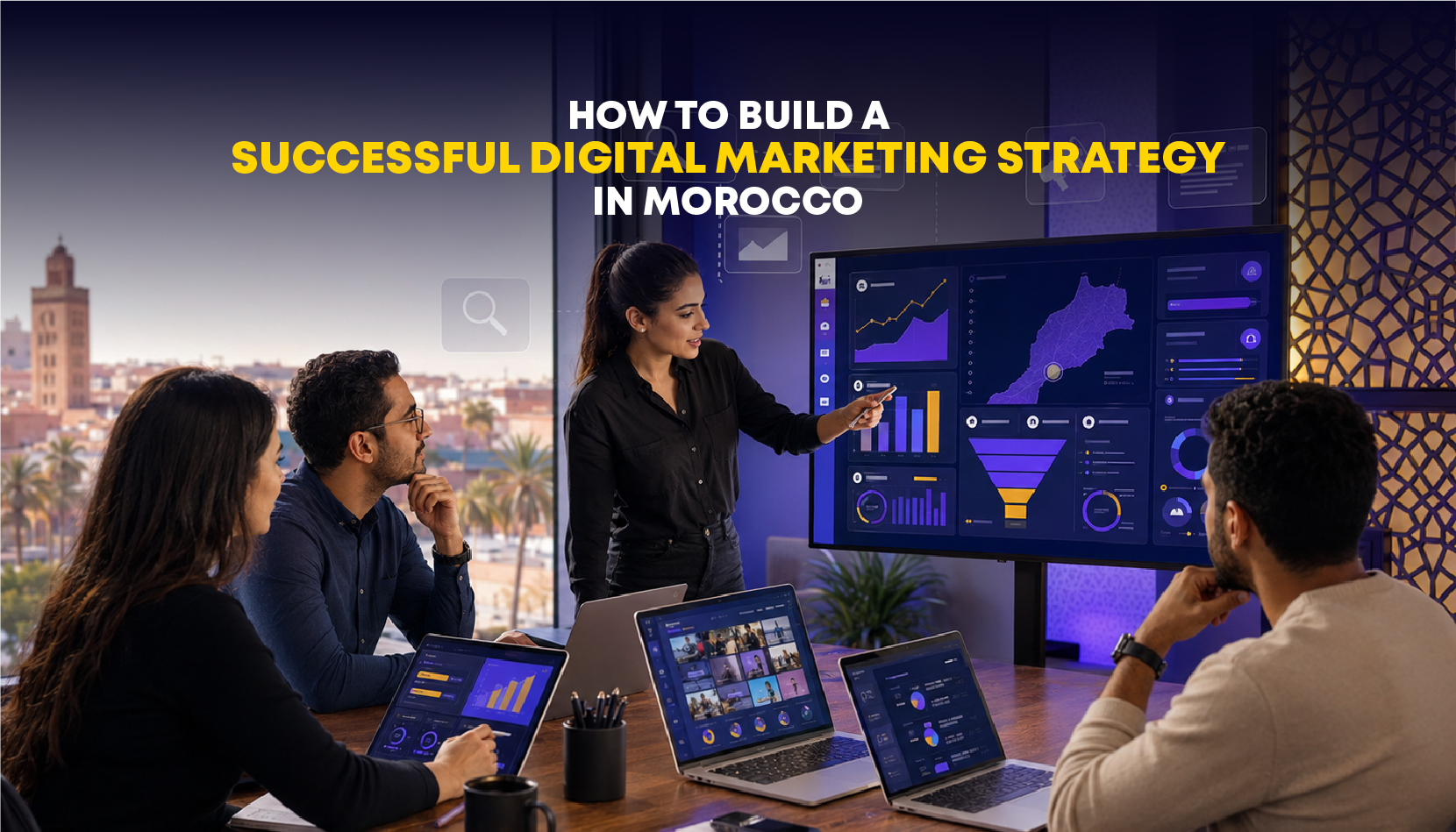
Digital marketing has become essential for businesses that want to attract customers, strengthen their reputation and increase sales in Morocco.
Consumers now use search engines, social media, websites and online reviews before choosing a company. A business may offer an excellent product or service, but without a clear online presence, potential customers may never discover it.
However, successful digital marketing is not simply about publishing regularly on Instagram or launching occasional advertisements. It requires a coordinated strategy connecting your brand, website, content, social media, advertising and customer journey.
This guide explains how to build an effective digital marketing strategy in Morocco and create measurable long-term growth.
What Is a Digital Marketing Strategy?
A digital marketing strategy is a structured plan that explains how a business will use online channels to reach its objectives.
It determines:
- Who the business wants to reach
- What message it should communicate
- Which platforms it should use
- What content it should produce
- How much it should invest
- How results will be measured
- How prospects will become customers
Without a strategy, businesses often publish disconnected content, target the wrong audience or spend money on advertising without generating meaningful results.
A strong strategy ensures that every digital activity supports a clear business objective.
1. Define Clear Marketing Objectives
The first step is to determine what the business wants to achieve.
Possible objectives include:
- Increasing brand awareness
- Generating qualified leads
- Receiving more quotation requests
- Increasing online or in-store sales
- Attracting visitors to a website
- Developing a professional reputation
- Entering a new market
- Promoting a specific product
- Building customer loyalty
Objectives should be specific and measurable.
Instead of choosing a general objective such as “increase visibility,” define a result such as:
Increase qualified website enquiries from Moroccan businesses during the next six months.
This makes it easier to select the right channels and evaluate performance.
2. Understand Your Target Audience
Effective marketing begins with a clear understanding of the customer.
Identify:
- Age group
- Location
- Language
- Professional profile
- Interests
- Purchasing behaviour
- Main challenges
- Preferred platforms
- Factors influencing the decision
- Common questions and objections
A company targeting business owners in Casablanca will need a different strategy from a consumer brand targeting young customers across Morocco.
Language is also important. Depending on the audience, content may be produced in:
- Arabic
- Darija
- French
- English
- A combination of languages
Internationally focused companies can use English for their main communication while providing French or Arabic versions for the Moroccan market.
3. Analyse Your Current Digital Presence
Before creating a new strategy, review the company’s existing digital presence.
Evaluate:
- Website design and performance
- Google visibility
- Social media profiles
- Brand consistency
- Published content
- Online reviews
- Advertising campaigns
- Competitor activity
- Lead-generation process
- Analytics and tracking
Ask the following questions:
- Can customers understand the offer quickly?
- Does the website work properly on mobile devices?
- Is the company visible on Google?
- Are contact details easy to find?
- Does the content look professional and consistent?
- Are enquiries answered quickly?
- Which platforms currently generate the best results?
The audit helps identify both weaknesses and opportunities.
4. Build a Strong Brand Identity
A recognizable brand is easier to remember and trust.
A professional visual identity usually includes:
- Logo
- Colour palette
- Typography
- Photography style
- Graphic elements
- Tone of communication
- Brand message
- Usage guidelines
The identity should remain consistent across the website, social media, advertisements, videos, presentations and printed materials.
Consistency does not mean every post must look identical. It means the audience should recognize the company through its colours, style, message and overall personality.
5. Create a Professional Website
Social media platforms are important, but the website remains the central digital asset of a business.
A professional website should:
- Clearly explain the company’s services
- Present previous work or products
- Build credibility
- Load quickly
- Work correctly on mobile devices
- Make contact easy
- Include clear calls to action
- Be optimized for search engines
- Support multiple languages when necessary
Essential pages may include:
- Homepage
- About
- Services
- Portfolio or projects
- Blog
- Contact
- Privacy policy
Every important service should ideally have its own page. This allows the company to provide detailed information and target relevant Google searches.
6. Improve Visibility With SEO
Search engine optimization helps a website appear when potential customers search for related services.
SEO usually includes:
- Keyword research
- Optimized page titles
- Meta descriptions
- Clear heading structure
- High-quality content
- Image optimization
- Internal links
- Mobile performance
- Website speed
- Technical indexing
- Local SEO
- Relevant backlinks
For example, a company operating in Morocco may target searches such as:
- Digital marketing agency in Morocco
- Web design agency Morocco
- Event production company Morocco
- Corporate video production Morocco
- Marketing agency in Casablanca
SEO is generally a long-term process. Results develop progressively as the website publishes useful content, improves technically and builds authority.
7. Develop a Content Marketing Strategy
Content allows a company to demonstrate its expertise before asking the audience to purchase.
Useful content formats include:
- Blog articles
- Educational social media posts
- Short videos
- Reels
- Case studies
- Client testimonials
- Guides
- Infographics
- Email newsletters
- Behind-the-scenes content
- Frequently asked questions
Content should address real customer needs.
For example, an event production agency could publish articles about:
- Event production costs
- Corporate event planning
- Choosing an event venue
- Livestreaming requirements
- Conference audiovisual equipment
A digital agency could publish content about SEO, websites, branding, advertising and social media strategy.
8. Choose the Right Social Media Platforms
Businesses do not need to be active on every platform. They need to be present where their customers spend time.
Instagram is useful for visual brands, agencies, hospitality, fashion, fitness, food, beauty, real estate and event companies.
Effective formats include:
- Reels
- Carousels
- Stories
- Project presentations
- Behind-the-scenes content
- Testimonials
Facebook remains useful for reaching broad local audiences, managing communities and running targeted advertising campaigns.
LinkedIn is particularly valuable for:
- B2B companies
- Agencies
- Consultants
- Corporate services
- Recruitment
- Institutions
- International partnerships
Content should demonstrate expertise, results, professional experience and industry knowledge.
TikTok
TikTok can help brands reach large audiences through short, engaging and educational videos.
The content should feel natural and adapted to the platform rather than simply reusing traditional advertisements.
YouTube
YouTube is suitable for tutorials, interviews, podcasts, company presentations, case studies and long-form educational content.
The right selection depends on the audience, resources and business model.
9. Use Paid Advertising Strategically
Paid advertising can generate visibility and leads faster than organic content alone.
Common channels include:
- Google Ads
- Meta Ads
- LinkedIn Ads
- TikTok Ads
- YouTube advertising
Before launching a campaign, define:
- Campaign objective
- Target audience
- Geographic area
- Budget
- Offer
- Message
- Creative format
- Landing page
- Conversion action
- Tracking method
Advertisements should send visitors to a relevant page, not automatically to the homepage.
For example, an advertisement promoting corporate video production should direct visitors to a dedicated video-production page with examples and a clear contact button.
10. Combine Organic and Paid Marketing
Organic marketing builds visibility and credibility over time. Paid marketing provides faster reach and controlled targeting.
A balanced strategy can include:
- SEO for long-term Google visibility
- Regular social media content
- Blog articles demonstrating expertise
- Paid campaigns for priority services
- Remarketing for previous website visitors
- Email follow-up for existing prospects
Paid advertising should support a strong digital foundation. Advertising cannot permanently compensate for a confusing website, weak offer or inconsistent brand identity.
11. Optimize the Customer Journey
Generating attention is only the beginning. The process between discovery and purchase must be simple.
A typical customer journey may look like this:
- The customer discovers the company through Google or social media.
- They visit the website or profile.
- They review services, projects and customer feedback.
- They contact the company.
- The company qualifies the request.
- A quotation or consultation is provided.
- Follow-up converts the prospect into a customer.
At every stage, potential customers should understand what to do next.
Useful calls to action include:
- Request a quotation
- Book a consultation
- View our projects
- Send us your brief
- Contact our team
- Discover our services
12. Strengthen Local Visibility
Businesses serving Moroccan customers should optimize their local presence.
Important actions include:
- Creating a complete Google Business Profile
- Using the correct business category
- Adding services and photographs
- Publishing regular updates
- Collecting authentic customer reviews
- Responding professionally to reviews
- Keeping contact information consistent
- Mentioning service areas naturally
- Creating location-relevant website content
Local visibility is particularly important for searches containing city names such as Kénitra, Rabat, Casablanca, Marrakech or Tangier.
13. Measure Digital Marketing Performance
Digital marketing decisions should be based on data.
Important indicators may include:
- Website visitors
- Google impressions
- Search rankings
- Social media reach
- Engagement rate
- Video views
- Click-through rate
- Enquiries
- Qualified leads
- Conversion rate
- Cost per lead
- Customer acquisition cost
- Revenue generated
The most important indicators depend on the business objective.
A post receiving many likes may appear successful, but it has limited commercial value if it does not contribute to visibility, enquiries, trust or sales.
14. Review and Improve the Strategy
A digital marketing strategy should evolve according to performance data and market changes.
Review the results regularly to identify:
- Best-performing content
- Most profitable channels
- Strongest audience segments
- Pages generating enquiries
- Keywords gaining visibility
- Advertisements producing leads
- Areas needing improvement
Keep what works, improve weak elements and test new ideas gradually.
Avoid changing every part of the strategy at the same time, because this makes it difficult to understand which action influenced the result.
Common Digital Marketing Mistakes
Businesses should avoid these frequent mistakes:
- Publishing without a strategy
- Trying to use every platform
- Buying followers or artificial engagement
- Neglecting the website
- Ignoring mobile users
- Using inconsistent visuals
- Launching advertisements without tracking
- Targeting an audience that is too broad
- Focusing only on followers and likes
- Ignoring customer reviews
- Expecting immediate SEO results
- Failing to follow up with prospects
Effective digital marketing is based on consistency, relevance and continuous improvement.
Digital Marketing Strategy Checklist
Before launching your strategy, confirm that you have:
- Defined measurable objectives
- Identified your target audience
- Analysed your competitors
- Audited your online presence
- Established a consistent brand identity
- Created a professional website
- Optimized important pages for SEO
- Selected the right social platforms
- Prepared a content calendar
- Defined an advertising budget
- Installed analytics and conversion tracking
- Created clear calls to action
- Planned lead follow-up
- Established monthly performance reports
Frequently Asked Questions
How much should a business invest in digital marketing?
The appropriate budget depends on the company’s objectives, industry, audience and competition. The budget should account for strategy, content production, advertising, website improvements and performance monitoring.
How long does SEO take to produce results?
SEO is a long-term strategy. Initial improvements may appear progressively, while stronger visibility often requires consistent technical work and useful content over several months.
Which social media platform is best for businesses in Morocco?
The best platform depends on the target audience. Instagram and Facebook are useful for many consumer businesses, while LinkedIn is particularly effective for professional and B2B communication.
Does every company need a website?
A professional website is strongly recommended because it gives the company control over its content, credibility, search visibility and customer journey.
Should businesses use French, Arabic or English?
The language should reflect the target audience. Moroccan companies may combine Arabic, Darija and French, while businesses targeting international customers can prioritize English and provide localized versions.
Can CAPART MEDIA manage a complete digital strategy?
Yes. CAPART MEDIA can coordinate strategy, branding, websites, SEO, content creation, social media, advertising, photography and audiovisual production according to the company’s objectives.
Build Your Digital Presence With CAPART MEDIA
A successful digital marketing strategy connects strong branding, useful content, an effective website, social media, SEO and targeted advertising.
CAPART MEDIA helps businesses, institutions and organizations develop professional digital strategies for Morocco and international markets.
Explore our creative and digital services or contact CAPART MEDIA to discuss your project.